



Green Hydrogen, Solar, EVs: Positioning Your Portfolio for India's Energy Transition
1. Introduction: When markets feel noisy, future themes feel safer
Let's be honest, markets don't feel calm anymore. One day it's global slowdown, next day it's oil prices, interest rates, wars, elections… too much noise. When things feel this uncertain, investors naturally start looking for themes that are not just "hot today" but relevant for the next 20–30 years.
And that's exactly where India's energy transition comes in.
Green hydrogen, solar power, electric vehicles, these aren't just buzzwords. They're part of a massive shift that India is already in the middle of. Governments are pushing it, corporates are investing big money, and global capital is flowing into it.
Most folks don't realize this, but themes like these often create the biggest long-term wealth, not overnight, but steadily. If you're serious about understanding how such themes work and how to invest smartly, learning from the right place matters. Many people start with proper share market classes in pune, to build proper fundamentals instead of guessing.
2. Why India's energy transition is not optional anymore
India is growing fast. Population, urbanisation, manufacturing, consumption, everything's going up. But energy supply based on coal and oil has limits. Pollution, import bills, global pressure, climate commitments… all of it adds up.
India has already committed to:
- Net zero emissions by 2070
- 500 GW renewable energy capacity by 2030
- Large-scale EV adoption
- Reducing dependence on oil imports
This isn't a wish list. Policies, subsidies, PLI schemes, and regulations are already in place. Companies that align with this shift will survive and grow. Those that don't will struggle.
From an investor point of view, this transition is not risk, it's opportunity.
3. Solar power: The backbone of India's clean energy push
Solar is no longer "new tech". It's mainstream.
Cost of solar power has dropped massively in the last decade. Today, solar is often cheaper than coal-based electricity. That's a game-changer.
India is investing heavily in:
- Solar power plants
- Rooftop solar
- Solar manufacturing (panels, modules, cells)
- Storage and grid integration
Example:
Companies like Adani Green, Tata Power, and ReNew Power have built massive solar capacities. Long-term power purchase agreements (PPAs) give predictable revenue. Investors who understood this early saw steady value creation, not just price spikes.
To be honest, solar stocks may look boring sometimes. But boring businesses with predictable cashflows often create the best wealth.
4. Electric vehicles: Not just cars, a full ecosystem
When people hear EV, they think of cars and bikes. But EV is much bigger than that.
The EV ecosystem includes:
- Vehicle manufacturers
- Battery makers
- Charging infrastructure
- Power utilities
- Software and electronics suppliers
India's EV adoption is driven by:
- High fuel costs
- Government incentives
- Lower running cost of EVs
- Pollution concerns in cities
Two-wheelers and three-wheelers are already seeing rapid EV adoption. Buses and commercial fleets are next.
Example:
Companies like Tata Motors pivoted early into EVs. Initial years were slow, margins were thin, people doubted. But as volumes grew and ecosystem improved, market perception changed. Long-term investors benefited.
EV investing is not about chasing the latest launch. It's about understanding who will benefit across the value chain.
5. Green hydrogen: Early stage, high potential
Now this is where things get interesting.
Green hydrogen is still early. Very early. But the potential is massive.
Green hydrogen can be used in:
- Steel manufacturing
- Fertilisers
- Refineries
- Heavy transport
- Energy storage
India wants to become a global green hydrogen hub. Large industrial groups are already investing in pilot projects and capacity building.
But let me be very clear, this is not a short-term story. Revenue may take years to show. Volatility will be high. Narratives will change.
This is where patience matters.
Investors who understand early-stage themes don't expect instant profits. They position slowly, diversify, and wait for execution.
6. How these three themes connect together
Solar, EVs, and Green hydrogen are not isolated.
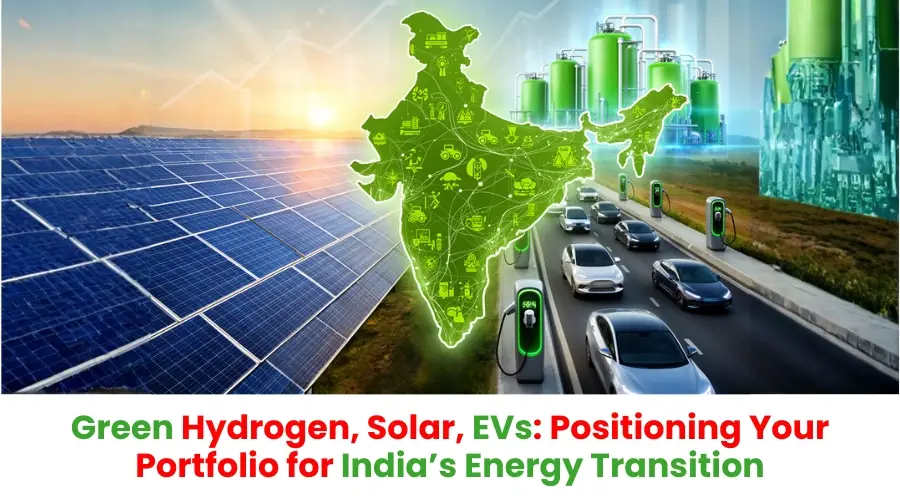
Solar generates clean electricity, EVs consume electricity instead of petrol, and Green hydrogen stores and uses renewable energy for heavy industry.
It's a connected loop.
Companies working across multiple parts of this loop often have stronger long-term positioning. Understanding this connection helps you avoid random stock picking.
7. How to position your portfolio without gambling
This is important.
Many investors make one mistake, they go all-in on a theme. That's dangerous.
A smarter approach:
- Allocate only a portion of your portfolio (say 15–30%) to energy transition
- Diversify across solar, EV, utilities, and ancillaries
- Prefer companies with strong balance sheets
- Avoid pure story stocks with no execution
To be honest, you don't need to catch every multibagger. Even a few solid winners held long-term can change portfolio outcomes.
8. Risks you must be aware of
- Policy changes
- Execution delays
- High capital expenditure
- Global competition
- Technology shifts
That's why stock selection matters more than theme selection.
Don't just invest because it's "green". Invest because the company can survive and execute.
9. Mutual funds and ETFs: A safer entry
If picking stocks feels overwhelming, mutual funds and ETFs focused on:
- Energy
- Infrastructure
- ESG
- Manufacturing
Can be a safer way to get exposure. Fund managers diversify risk and track multiple players. This works well for beginners or conservative investors.
10. Why timing matters, but patience matters more
Energy transition is a long journey. Ups and downs are normal.
Trying to time perfect entry usually leads to missed opportunities. Systematic investing or gradual allocation works better.
If you ask me, the biggest money in this theme will be made by people who stay invested for a decade, not a year.
11. Conclusion: Future focused investing needs calm thinking
India's energy transition is real. Solar, EVs, and green hydrogen are not trends, they're structural shifts. Markets will move up and down. Headlines will confuse. Prices will fluctuate. But businesses aligned with long-term national priorities usually come out stronger.
If you want to position your portfolio thoughtfully and not emotionally, start by building knowledge. Explore trading courses in pune, or structured trading courses online to understand how themes turn into wealth over time.
Because in investing, the future rewards those who prepare early, not those who panic late.
12. Disclaimer
This blog is provided for general information only and does not represent financial advice. Please take investment decisions after consulting a SEBI registered financial advisor. Past performance is not indicative of future outcomes. Investments have inherent market risks, learn before you earn.
13. Frequently Asked Questions (FAQs)
Q1. Is investing in green hydrogen, solar, and EVs risky?
There is some risk, especially in early-stage companies. But long-term demand and government support reduce overall uncertainty if you choose strong businesses.
Q2. Should beginners invest in energy transition stocks?
Yes, but slowly. Beginners should start with diversified funds or large, financially stable companies instead of pure speculative plays.
Q3. How much of my portfolio should be in this theme?
Generally 15–30% is sensible. Never go all-in on one theme, no matter how promising it looks.
Q4. Are mutual funds better than direct stocks for this sector?
For many investors, yes. Mutual funds and ETFs spread risk and reduce the impact of wrong stock selection.
Q5. Is this a short-term or long-term investment idea?
Definitely long-term. India's energy transition will take years, so patience is key.